Types and Sizes of Shipping Containers: Specifications and How to Choose the Right One
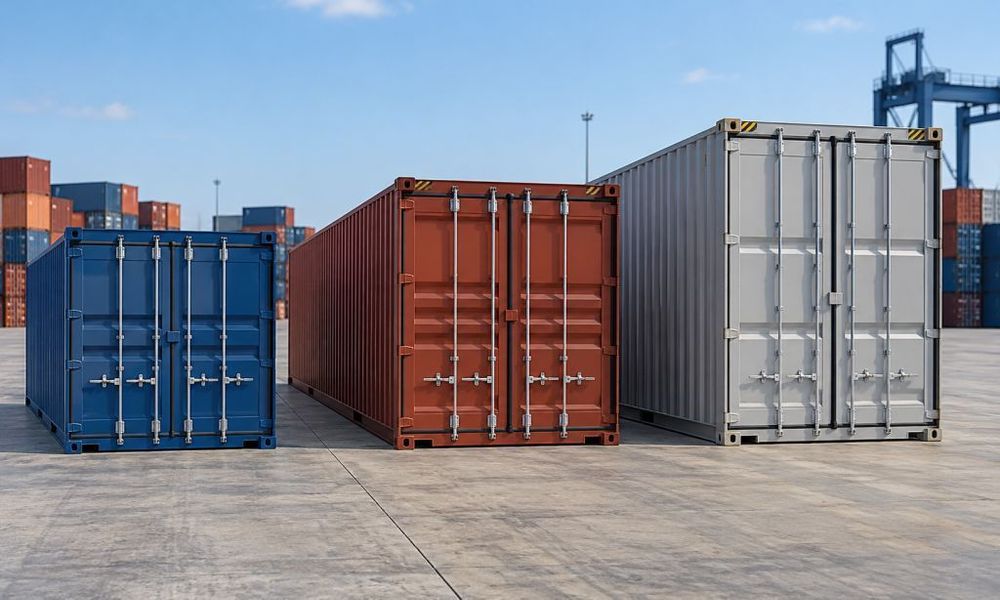
Choosing the right shipping container affects cargo safety, loading efficiency, and overall transportation costs.
International logistics relies on containers of various sizes and designs. The most common types include standard 20-foot and 40-foot containers, as well as High Cube containers offering additional cargo capacity.
For shipments with specific handling or transportation requirements, specialised equipment such as refrigerated containers, Open Top containers, and Flat Racks is available.
This guide covers their main specifications and practical applications.
Standard Shipping Containers: 20', 40' and 40' High Cube
Standard dry containers are used to transport a wide range of goods, including industrial products, machinery, furniture, electronics, packaged consumer goods, and other cargo that does not require temperature control.
Main Specifications
| Specification | 20' Dry | 40' Dry | 40' High Cube |
| External length, m | 6.058 | 12.192 | 12.192 |
| External width, m | 2.438 | 2.438 | 2.438 |
| External height, m | 2.591 | 2.591 | 2.896 |
| Internal length, m | 5.900 | 12.032 | 12.032 |
| Internal width, m | 2.352 | 2.352 | 2.350 |
| Internal height, m | 2.395 | 2.395 | 2.700 |
| Door opening (W × H), m | 2.340 × 2.292 | 2.340 × 2.292 | 2.340 × 2.597 |
| Internal volume, m³ | 33.2 | 67.7 | 76.3 |
| Maximum gross weight, kg | 30,480 | 32,500 | 32,500 |
| Maximum payload, kg | 28,130 | 28,750 | 28,600 |
The specifications shown are indicative examples of container equipment. Actual dimensions, tare weight, and payload capacity may vary depending on the manufacturer and the individual container. Equipment specifications and route restrictions should always be confirmed before booking.
20-Foot Dry Container (20' Dry)
The 20-foot dry container is one of the most widely used container types in international freight transportation.
Its compact dimensions and relatively high payload capacity make it suitable for heavy cargo that does not require a large amount of space.
Typical cargo includes metal products, industrial components, construction materials, and machinery.
40-Foot Dry Container (40' Dry)
A standard 40-foot container provides approximately twice the internal volume of a 20-foot container.
It is suitable for bulky cargo where efficient use of container space is a priority.
Typical cargo includes furniture, textiles, packaged consumer goods, and palletised products.
However, a larger internal volume does not mean twice the permissible cargo weight.
40-Foot High Cube Container (40' HC)
The 40-foot High Cube container offers additional height compared with a standard 40-foot container.
Its external height is approximately 30 cm greater, while the internal height is around 2.7 m.
This provides additional usable volume, making High Cube containers particularly suitable for tall or bulky shipments.
They can be an efficient option for lightweight goods, large packages, furniture, or equipment requiring additional vertical clearance.
45-Foot High Cube Container (45' HC)
The 45-foot High Cube is an extended-length, high-capacity container designed for bulky cargo.
Its external length is approximately 13.7 m, while its internal volume can reach around 86 m³, depending on the container design.
This type is suitable for large-volume, relatively lightweight cargo where available space is a more important consideration than payload weight.
45-foot containers are not available on every shipping route. Equipment availability, port handling capabilities, and inland transportation restrictions must be confirmed with the relevant shipping line.
Specialised Shipping Containers
Not all cargo can be transported safely in standard dry containers.
Certain shipments require specialised equipment designed to accommodate specific cargo characteristics, dimensions, weight, or transportation conditions.
Refrigerated Containers (Reefers)
Refrigerated containers are designed to transport goods that require controlled temperatures.
They are commonly used for food products, pharmaceuticals, flowers, and other temperature-sensitive cargo.
The most common types include:
- 20' Reefer
- 40' High Cube Reefer
Unlike standard dry containers, reefers are equipped with temperature-control systems. Their insulation and refrigeration equipment generally reduce the available internal space.
Temperature settings, ventilation, and other operating parameters must be agreed upon according to the requirements of the specific cargo.
Open Top Containers
Open Top containers have no fixed rigid roof. Their top opening is typically covered with a removable tarpaulin.
This design allows cargo to be loaded from above, including by crane.
Open Top containers are used for shipments that are difficult or impossible to load through standard container doors.
Typical examples include:
- industrial machinery
- oversized structures
- certain types of equipment and mechanical units
If the cargo exceeds the container's standard dimensions, special approval from the shipping line is required.
Flat Rack Containers
Flat Rack containers are specialised loading platforms with end walls that may be fixed or collapsible.
They are designed for heavy, wide, or oversized cargo that cannot be accommodated in a standard container.
Typical examples include:
- industrial machinery
- construction equipment
- oversized industrial units
- steel structures
Proper load distribution, centre of gravity, and secure cargo lashing are particularly important for such shipments.
Cargo extending beyond the standard container dimensions requires prior approval from the shipping line. In addition to cargo dimensions and weight, port handling capabilities and transportation restrictions along the route must be considered.
How to Choose the Right Shipping Container
Selecting a container requires more than simply calculating the total cargo volume.
Several technical factors should be considered.
1. Cargo Dimensions
The actual dimensions of each pallet, package, or piece of equipment must be known, including its packaging.
This helps determine whether the cargo can be accommodated and how efficiently the container's internal space can be used.
2. Total Cargo Weight
The permissible payload of the specific container must be checked, along with any applicable restrictions for the route and inland transport equipment.
The maximum gross weight includes both the container's tare weight and its cargo. It should not be confused with the maximum permissible payload.
3. Door Opening Dimensions
Cargo may physically fit inside the container but still be too large to pass through its doors.
Door opening dimensions should therefore be checked separately, particularly for tall pallets, machinery, and non-standard cargo units.
4. Loading Method
Standard containers are generally loaded through their end doors.
Oversized machinery may require top loading or specialised equipment, such as Open Top or Flat Rack containers.
5. Special Transportation Requirements
Temperature control, cargo characteristics, securing requirements, and the need for specialised equipment can determine the appropriate container type.
For example, temperature-sensitive products may require a reefer, while oversized shipments may need an Open Top or Flat Rack container.
FCL vs LCL: Do You Always Need a Full Container?
Not every shipment requires booking an entire container.
International container transportation generally offers two main shipping options:
FCL (Full Container Load) – a shipment transported in a dedicated container rather than consolidated with other shippers' cargo through a standard LCL service.
LCL (Less than Container Load) – consolidated cargo transportation, where shipments from different shippers are combined in one container.
FCL can be suitable not only for large shipments but also for cargo that requires a dedicated container due to its handling, securing, product characteristics, or transportation requirements.
LCL allows smaller shipments to be transported without paying for an entire container.
The choice between FCL and LCL depends on cargo volume, weight, characteristics, route, transit time, and transportation costs.
Why Container Specifications Should Be Checked Before Booking
Choosing an unsuitable container may require changes to the loading plan, alternative equipment, or adjustments to the transportation arrangements.
Advance verification is especially important for:
- heavy cargo
- tall or oversized packages
- irregularly shaped machinery
- goods requiring temperature control
- shipments with special loading and securing requirements
Proper planning helps reduce the risk of unexpected costs, delays, and additional cargo handling.
Planning a Container Shipment?
Share your cargo details, dimensions, weight, and destination with our team.
We will help you select the appropriate container type and find the most suitable logistics solution based on your cargo characteristics, route, and transportation requirements.
The container dimensions and specifications provided in this article are for reference purposes only. Actual equipment characteristics, permissible payload, and container usage conditions must be confirmed when arranging transportation.