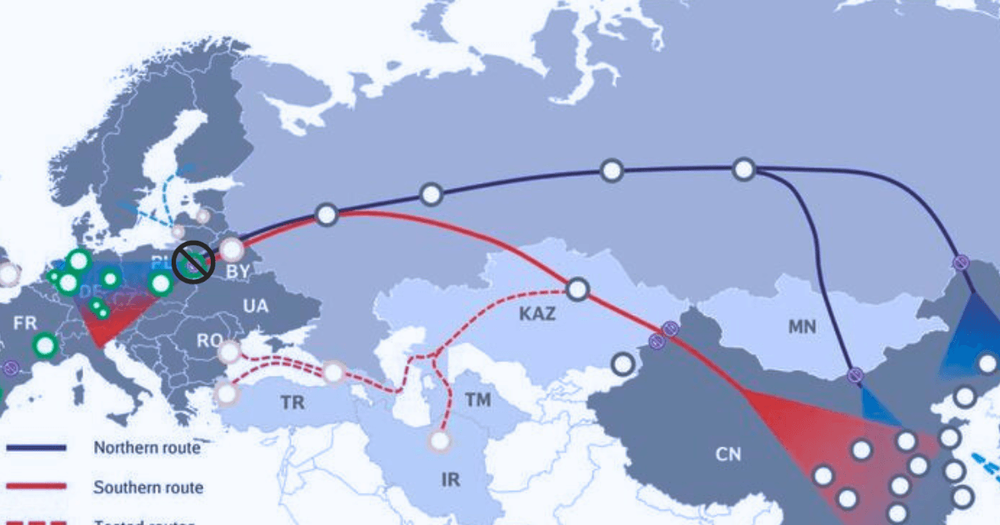
In September 2025, Poland temporarily closed all border crossings with Belarus amid security risks linked to large-scale military drills. The decision effectively disrupted one of the key overland routes between China and the EU: shipments were stranded, while rates and lead times increased sharply.
At the same time, tighter controls in neighboring countries added further pressure on alternative gateways. As a result, many companies started looking beyond short-term fixes and toward a strategic routing alternative.
TMTM (Trans-Caspian / Middle Corridor) as an alternative
The route via Kazakhstan — the Caspian Sea — Azerbaijan — Georgia — Turkey is increasingly viewed as a viable diversification option for supply chains. According to corridor participants and industry sources, 2024 transport volumes grew by 62% and exceeded 4.5 million tonnes, with a 2025 forecast of over 5.2 million tonnes.
Why interest in TMTM is growing
Route stability: reduced dependency on a single local bottleneck thanks to its multimodal structure.
Predictability: load distribution across multiple links lowers the risk of sudden stops.
Flexibility: the chain can be quickly reconfigured as conditions change.
Formag Forwarding’s role
With operational presence across key markets along this corridor (including Azerbaijan, Kazakhstan, Uzbekistan, and Poland), we coordinate shipments locally and maintain transparency across multimodal, door-to-door supply chains.